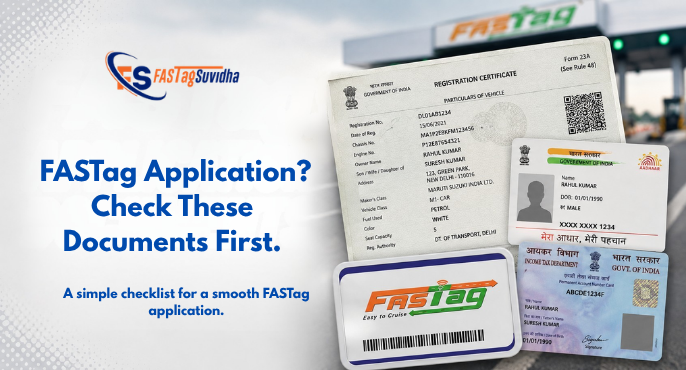
FASTag needs three documents at minimum: your vehicle’s Registration Certificate (RC), a valid ID for KYC, and a recent passport-size photo. Depending on whether you choose Minimum KYC or Full KYC, you may also need a separate address proof. Here is the complete, updated FASTag documents list so your application isn’t rejected or delayed.
Key Takeaways
- RC (Registration Certificate) is mandatory for every FASTag application – it links the tag to your vehicle.
- ID proof can be Aadhaar, PAN, Passport, Voter ID, or Driving Licence.
- Minimum KYC needs only the RC and mobile number, but caps your wallet balance.
- Full KYC needs ID + address proof and unlocks a higher balance and annual limit.
- Commercial vehicles and fleet owners need extra documents, like company registration and an authorization letter.
- As of February 2026, new-vehicle FASTags no longer require separate KYV (Know Your Vehicle) re-verification- KYC still applies.
What Is FASTag KYC and Why Does It Matter?
FASTag is an RFID-based tag that automatically deducts toll charges from a linked prepaid wallet or bank account when your vehicle crosses a toll plaza. Because it’s tied to both a vehicle and a payment method, the National Highways Authority of India (NHAI) requires banks and issuers to verify your identity and vehicle details before activating it. This verification process is called KYC (Know Your Customer).
Skipping or delaying KYC isn’t just a formality issue. A FASTag with incomplete KYC can get deactivated, and current NHAI rules mean a non-KYC tag can trigger a double toll charge at the plaza, with the wallet balance temporarily blocked until verification is completed. Getting your documents right the first time saves both money and hassle later.
Core Documents Required for FASTag
1. Vehicle Registration Certificate (RC)
The RC is the single most important document in your application. It confirms your vehicle’s registration number, chassis number, vehicle class, and owner’s name – details that get mapped directly to your FASTag. Since the tag is issued specifically for the vehicle listed on the RC, any mismatch (a typo, an outdated address, or an unrecorded ownership transfer) can delay approval.
2. Identity Proof
You’ll need one valid, government-issued ID. Accepted options typically include:
- Aadhaar Card
- PAN Card
- Passport
- Voter ID Card
- Driving Licence
Most issuers accept any one of these, though individual banks sometimes have specific preferences — it’s worth checking your chosen issuer’s app before applying.
3. Address Proof
For Full KYC, you’ll need a separate address proof unless your ID document already doubles as one. Aadhaar, Passport, and Driving Licence are commonly accepted for both identity and address verification. If your primary ID doesn’t show an address, a recent utility bill or bank statement usually works. The address on this document should match the address on your RC, or your application may face extra scrutiny.
4. Passport-Size Photograph
A recent passport-size photo of the vehicle owner, or the authorized signatory for company-owned vehicles, is required for the FASTag sticker and issuer records. For online applications, you’ll upload a digital copy – most issuers cap file size and resolution, so check the guidelines before uploading.
Minimum KYC vs. Full KYC: What’s the Difference?
Banks and FASTag issuers offer two verification tiers, and the documents you submit determine which one you get:
| KYC Type | Documents Needed | Wallet Limit | Best For |
| Minimum KYC | RC + mobile number + basic self-declaration | Capped (often around ₹10,000/month) | Occasional drivers, quick setup |
| Full KYC | RC + ID proof + address proof | Higher limits (up to ₹1 lakh/year or more) | Frequent travellers, fleet owners, commercial use |
If you commute daily or run multiple vehicles, Full KYC is worth the extra paperwork upfront -it avoids repeatedly hitting wallet limits mid-month.
Additional Documents for Commercial Vehicles
Commercial and fleet vehicle owners need to submit a slightly longer list:
- Vehicle RC (original, for verification)
- Identity proof of the authorized signatory
- Passport-size photograph of the signatory
- Company or business registration documents
- An authorization letter, if the applicant isn’t the vehicle’s registered owner
For fleet operators applying for multiple tags at once, the name on each RC should match the company’s registered details exactly – mismatches here are one of the most common reasons commercial FASTag applications get stuck in verification.
How to Apply for FASTag: A Quick Overview
- Choose your issuer. FASTag is issued by NHAI-authorized banks (SBI, HDFC, ICICI, IDFC First, Axis) and payment platforms like Paytm.
- Pick your application mode. Apply online through the issuer’s app or website, at a toll plaza POS counter, at a bank branch, or through an authorized FASTag agent or Suvidha Kendra.
- Submit your documents. Upload or hand over your RC, ID proof, address proof (if applicable), and photograph.
- Complete KYC verification. This can happen instantly for online applications or take a few working days for manual review – usually 1–3 business days.
- Pay the issuance fee and minimum recharge. Once approved, you’ll pay a small tag fee plus an initial top-up amount.
- Receive and activate your tag. Stick it to your windscreen as instructed, and it’s ready to use at toll plazas.
What Happens If Your KYC Is Incomplete?
You’ll typically be notified by SMS, email, or an app notification if your KYC is pending. It’s worth checking proactively rather than waiting – you can log into your issuer’s FASTag portal or the NETC/IHMCL portal directly to check status. Leaving it unresolved risks deactivation, and a deactivated tag means paying tolls in cash, often at double the rate, until it’s resolved.
Frequently Asked Questions
Yes. The RC is the primary document required because the FASTag is issued specifically for the vehicle mentioned on it, including its registration number and vehicle class.
Yes, in most cases. Aadhaar is widely accepted as both ID proof and address proof by FASTag issuers, though acceptance can vary slightly by bank.
Yes. Even for online applications, you’ll need to upload a recent passport-size photograph as part of verification.
Commercial vehicle owners typically need company registration documents and an authorization letter for the signatory, along with the standard RC, ID proof, and photograph.
Online KYC updates are usually processed within 1 to 3 business days, though it can vary by issuer and application volume.
Online KYC updates are usually processed within 1 to 3 business days, though it can vary by issuer and application volume.
Your FASTag can get deactivated, and current NHAI rules may require paying double the toll amount in cash until KYC is completed and the tag is reactivated.
Looking to skip the paperwork? Fastag Suvidha’s authorized agents can help you apply, complete KYC, and activate your FASTag the same day – or explore our FASTag agent and franchise program if you’d like to offer these services yourself.