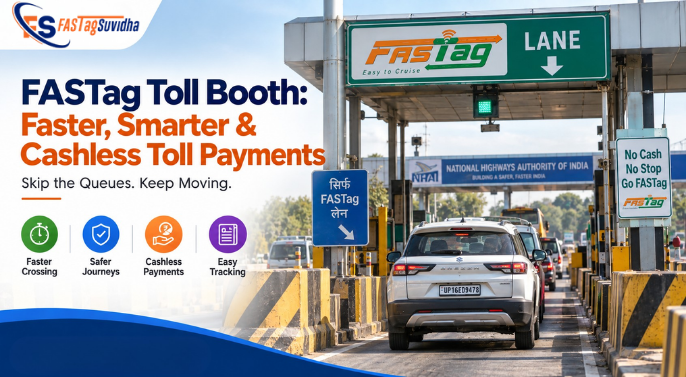
What Is a FASTag Toll Booth?
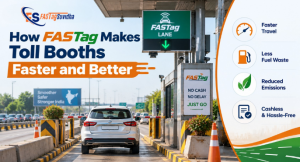
In simple terms: a FASTag toll booth is a toll collection point fitted with sensors that read a small prepaid RFID tag stuck on a vehicle’s windshield. As the vehicle approaches, the sensor detects the tag, calculates the toll for that vehicle class, and deducts the amount automatically from a linked wallet or bank account.
There is no need to stop, roll down a window, or hand over cash. The vehicle drives through the dedicated lane, and the payment happens in the background.
The system is operated under the National Highways Authority of India (NHAI), with day-to-day management handled by the Indian Highways Management Company Limited (IHMCL). It runs on RFID, or Radio Frequency Identification, the same basic technology used in many other contactless tracking systems.
For school buses that cross multiple toll points on longer routes, this single change removes one of the biggest sources of delay and unpredictability.
Why Toll Plazas Went Cashless in the First Place
Traditional toll booths relied on manual cash collection. Every vehicle had to stop, and every transaction added a few seconds, or a few minutes during peak hours.
Multiply that by hundreds of vehicles an hour, and you get the traffic jams that used to be common on highways across the country. NHAI pushed for a cashless system to cut down this congestion, reduce fuel wastage from idling vehicles, and bring more transparency into how toll money is collected and accounted for.
That shift is what led to the RFID-based tag system becoming mandatory for most vehicle categories on national highways, including commercial and school transport vehicles.
How Does It Actually Work?
Here is a simple breakdown of what happens each time a vehicle crosses a tag-enabled lane:
- The vehicle enters the dedicated FASTag lane at the toll plaza.
- An RFID scanner mounted above or beside the lane detects the tag on the windshield.
- The system identifies the vehicle class and calculates the applicable toll.
- The amount is deducted directly from the linked prepaid account or bank account.
- The barrier lifts, and the vehicle passes through without stopping.
- A confirmation message is usually sent to the registered mobile number.
The whole process takes just a couple of seconds, which is what makes the difference during busy school run hours. The tag itself is issued with a validity of several years, so once it is fitted and linked to an account, there is very little upkeep beyond keeping the balance topped up.
Why This Matters So Much for School Transport
School transport administrators deal with a unique set of pressures. Buses need to stick to a fixed schedule. Parents expect their children to reach home safely and on time. Any delay, especially one caused by something as avoidable as a toll queue, adds unnecessary risk.
Add to this the fact that many school routes cross the same toll plaza twice a day, once in the morning and once in the afternoon, and the savings in time and stress start to compound quickly across a full academic year.
Cashless toll payment through this system reduces that risk in a few concrete ways.
Fewer Stops Mean Safer Journeys
Every stop and start at a toll plaza is a moment where things can go wrong, whether it is a rear-end collision risk or a child leaning out of a window while the bus is halted. Passing through without stopping keeps the journey steadier and calmer for everyone on board.
Predictable Travel Times
When a bus does not have to guess whether the toll queue will take five minutes or twenty, administrators can plan pickup and drop-off schedules with more confidence. Parents also get a more accurate idea of when to expect their child home.
Easier Expense Tracking
Cash toll payments are hard to track across a fleet of buses. With an automated tag system, every transaction is recorded digitally, which makes monthly toll expense reports far simpler to put together for school accounts teams.
Key Benefits of a FASTag Toll Booth System
Here is a quick look at the practical advantages schools and transport operators notice once they switch over:
- No manual cash handling at toll points, reducing errors and pilferage
- Shorter waiting time at toll plazas, especially during school hours
- Automatic digital records of every toll transaction
- Lower fuel consumption since buses do not idle in queues
- Reduced chances of disputes over toll amounts
- Easier reconciliation of monthly transport expenses
- Better overall punctuality for pickup and drop schedules
Getting Set Up: What a School Needs to Know
Switching a fleet over is fairly straightforward, but a few details matter more for schools than for individual car owners.
- Each bus needs its own separate tag, linked to that specific vehicle’s registration number. Tags cannot be moved between vehicles, even within the same fleet.
- Tags can be obtained through authorised banks or point-of-sale agents, and most require basic KYC documents for the vehicle and the registered owner.
- The minimum recharge amount is generally kept low, so schools can top up small amounts frequently or set up a larger recharge for the whole term.
- Auto-recharge, linked to a bank account or prepaid wallet, is worth setting up for a fleet, since a single bus with an empty balance can hold up the tag lane for others behind it.
- Keeping a record of the tag ID against each bus’s registration number makes it easier to reconcile monthly statements later.
Common Mistakes Schools Make When Switching Over
Most transport administrators get the basics right, but a few small oversights tend to repeat across fleets. Knowing them in advance saves a lot of back-and-forth later.
- Treating the tag as a one-time setup. Balances run out, KYC documents expire, and bank account links can lapse. A tag needs periodic attention, not just an initial install.
- Not matching tag records to bus numbers. When a fleet has ten or twenty buses, it is easy to lose track of which tag belongs to which vehicle. A simple spreadsheet with registration number, tag ID, and linked account solves this.
- Ignoring low-balance alerts. Most issuers send a notification before the balance runs too low. If these go to a driver’s personal phone instead of the transport office, they often get missed.
- Assuming one contact person can manage the whole fleet. For larger schools, it helps to split responsibility, one person for recharges and account health, another for reconciling monthly statements against actual routes run.
- Forgetting to update details after a vehicle change. If an old bus is replaced or a route is reassigned to a different vehicle, the tag needs to move to the new registration number through the proper channel, not just get swapped physically.
None of these are complicated to fix, but they are the kind of small administrative gaps that cause the most frustration when a bus gets stopped at a toll plaza during school hours.
FASTag and GPS Tracking: A Natural Pairing
Toll payment is only one part of running a safe school transport system. Schools also need to know where their buses are at any given moment, whether they are on route, running late, or have made an unplanned stop.
This is where GPS tracking complements the toll system nicely. When a school bus is fitted with a GPS tracking device alongside its toll tag, administrators get a fuller picture: faster toll crossings combined with live location visibility. Parents get peace of mind, and transport managers get one less thing to worry about.
If your school is looking to combine reliable toll passage with the ability to plan and monitor routes, it helps to look at how FASTag services for toll booths are structured for fleet use, since bulk fleet requirements are usually a bit different from a single personal vehicle. Pairing this with a dedicated school bus tracking setup gives administrators one dashboard to manage both toll spend and live location, rather than juggling two separate systems.
Common Questions About Switching to This System for School Buses
Yes, each vehicle needs its own tag since it is linked to that specific vehicle’s registration number. You cannot transfer one tag between different buses, even within the same school fleet, so plan for one tag per vehicle.
If the balance is insufficient, the vehicle may get flagged and could face a double toll charge, or in some cases get stopped for manual payment. Setting up auto-recharge on the linked account is the simplest way to avoid this situation.
Yes, it has been made mandatory for most categories of vehicles on national highways, including commercial and school transport vehicles. Driving without one in a dedicated lane usually results in a penalty charge at the toll plaza
Coverage now extends to most state highway toll plazas as well, not just national highways. It has expanded significantly over the past few years, so most regular school bus routes should be covered.
Most providers offer a dashboard or statement showing transaction history for each linked vehicle. Schools can use this to consolidate monthly toll costs for the whole fleet without manually collecting receipts from every driver.
Yes, it is a nationwide system, so it works the same way regardless of which state the toll plaza is in. There is no need for separate tags or accounts when a bus route crosses state borders.
A Simple Step Forward for School Transport
Switching to a FASTag toll booth system is one of those changes that seems small on paper but makes a real difference on the road. Less waiting, fewer stops, and cleaner expense tracking add up to a smoother, safer commute for children every single day.
For official guidance on tag issuance, KYC requirements, and recharge rules, IHMCL’s FASTag user portal is a reliable reference point.
If your school transport fleet has not made the shift yet, or if you are managing toll payments alongside GPS tracking for multiple buses, it is worth taking a closer look at how this FASTag setup for toll booths can be configured for your fleet’s specific needs.