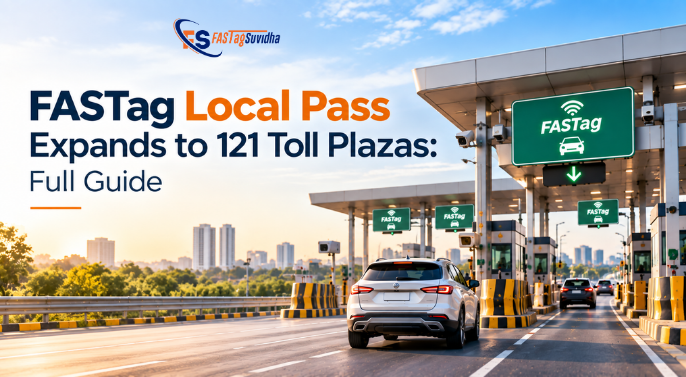
Living near a national highway toll plaza usually means one thing, paying full toll charges for trips that are barely local. A quick visit to the market, a daily office commute, or a school run across the plaza still costs the same as a long distance traveller passing through once. NHAI has now addressed this gap by expanding its FASTag Local Pass facility to 121 toll plazas across India.
This article explains what the Local Pass actually offers, who qualifies, how much it can save you, and how to apply, all in plain language, without the technical jargon that usually surrounds toll policy updates.
What Is the FASTag Local Pass
The FASTag Local Pass is a monthly facility for people who live within 20 kilometres of a toll plaza. Instead of paying the standard toll fee every time they cross, eligible residents pay a flat monthly charge of ₹350 and use that specific toll booth as often as they need.
This is not the same as a FASTag annual pass, which suits occasional, long distance travellers. The Local Pass is built for people whose daily life, not their travel plans, happens to cross a toll plaza. A shopkeeper restocking supplies, a parent dropping children to school, or an employee commuting to work are the kind of users this pass was designed for. Either way, your FASTag still needs to stay funded, so keeping an eye on your FASTag balance remains part of regular upkeep.
Why the Expansion to 121 Plazas Matters
Until recently, the Local Pass was limited to only 50 select toll plazas. That left a large number of residents near other highway stretches with no option but to pay full toll charges for what was essentially neighbourhood travel.
The expansion to 121 plazas changes that picture significantly. It is also part of a bigger shift, NHAI’s push toward digital, citizen first services that began with the MargMitra initiative in July 2026. Instead of paperwork and plaza office visits, residents can now apply entirely through their phone.
This matters because it reflects a change in how toll policy is being designed. The same flat toll rate no longer applies equally to a truck travelling across states and a resident crossing the plaza twice a day to reach their own town. The system is starting to account for that difference.
Who Qualifies for the Local Pass
Eligibility is based on one main factor, residence within 20 kilometres of a toll plaza that is part of the scheme. Applicants need to confirm their address falls within that radius and that the specific plaza they use is one of the 121 included.
People who typically benefit the most include:
- Daily commuters travelling to work, school, or college across a toll plaza
- Shop owners and small traders whose supply routes pass through a plaza
- Farmers transporting produce to nearby markets regularly
- Families making frequent short trips for healthcare, shopping, or visiting relatives
- Anyone whose home sits on one side of a highway and daily destinations on the other
One detail worth remembering, the pass applies to a specific plaza. If your routine involves crossing two different toll plazas, check whether both are part of the 121 covered locations, since you may need separate applications.
How Much You Can Realistically Save
A single crossing at most national highway toll plazas costs somewhere between ₹65 and ₹170 for private vehicles, depending on the stretch and vehicle category. For someone crossing daily, sometimes twice a day, this adds up fast over a month.
Here is a simple way to see the difference.
| Usage Pattern | Approx. Monthly Cost Without Local Pass | Monthly Cost With Local Pass |
| One crossing per day | ₹2,000 to ₹3,500 | ₹350 flat |
| Two crossings per day | ₹4,000 to ₹7,000 | ₹350 flat |
| A few crossings per week | ₹800 to ₹1,500 | ₹350 flat |
These figures vary by plaza, but the pattern holds across most locations. For regular users, the Local Pass often cuts monthly toll spending by more than half, and in daily double commute cases, by a much larger margin.
How to Apply for the FASTag Local Pass
The entire process is designed to be paperless and app based. Here is how it generally works.
- Confirm plaza eligibility. Check whether your nearby toll plaza is among the 121 included under the scheme, through the Rajmargyatra app or the NHAI website.
- Open the Rajmargyatra app. This is NHAI’s official platform for Local Pass applications, Annual Pass management, and highway related complaints.
- Submit address proof. You will need documentation confirming your residence falls within the 20 kilometre radius of the qualifying plaza.
- Link your existing FASTag. No new tag is required. Your current FASTag, already fitted on your vehicle, gets connected to the Local Pass once approved.
- Pay the monthly fee. Once verified, pay ₹350 for that billing cycle to activate reduced crossings at the designated plaza.
- Renew monthly. The pass does not auto renew indefinitely in all cases, so keep track of renewal dates to avoid a gap in benefits.
Because this runs fully through the app, there is no need to visit a toll plaza counter or submit physical paperwork, a major improvement over how the scheme worked when it covered only 50 plazas.
How the Local Pass Fits Into NHAI’s Larger FASTag Strategy
This update does not stand alone. It is one part of a broader pattern in how NHAI has been reshaping toll collection over the past year. The FASTag Annual Pass, introduced in August 2025, served long distance travellers by replacing repeated FASTag recharge cycles with a single yearly payment. The Local Pass addresses the opposite need, frequent, short distance crossings by people who live near the highway.
Seen together, these two passes show a clear direction in policy thinking. Toll payment is increasingly built around actual usage patterns rather than a single flat rate applied to everyone equally. For a household that has quietly absorbed high monthly toll costs simply because a highway runs near their home, this expansion offers direct, practical relief.
Points to Check Before You Apply
- Confirm the exact toll plaza covered under your application, since the pass is plaza specific.
- Keep your address proof updated and matching your current residence.
- No new FASTag purchase is needed, your existing tag works with the Local Pass.
- Set a reminder for monthly renewal, and check your FASTag balance regularly so a low balance does not interrupt your crossings.
- Apply only through the official Rajmargyatra app or NHAI website, and avoid third party links asking for personal documents.
Frequently Asked Questions
It is a monthly pass priced at ₹350 that lets residents living within 20 kilometres of a specific toll plaza cross it without paying the standard per trip toll fee.
The Local Pass is currently available at 121 toll plazas across India, expanded from the earlier limit of 50 select plazas.
No. The Local Pass connects to your existing FASTag. There is no need to install a new tag on your vehicle.
The Local Pass is built for residents who cross one specific toll plaza frequently for local travel. The Annual Pass is designed for long distance travellers using multiple toll plazas across the national highway network throughout the year.
Applications go through the official Rajmargyatra app or the NHAI website, both part of NHAI’s digital services under the MargMitra initiative.
No. The pass applies to the specific plaza it was issued for. Regular users of more than one eligible plaza may need to apply separately for each.
Final Thoughts
The expansion of the FASTag Local Pass to 121 toll plazas is a focused, practical change that directly helps residents who have long paid full toll charges for what is essentially local travel. With the entire process now handled through the Rajmargyatra app, applying has become faster and far less of a hassle than it used to be.
If you live near one of these 121 toll plazas, checking your eligibility is worth the five minutes it takes. A flat ₹350 monthly pass against toll charges that can otherwise reach ₹2,000 to ₹4,000 a month is a saving that adds up quickly, and one that is now within reach for far more residents across India.