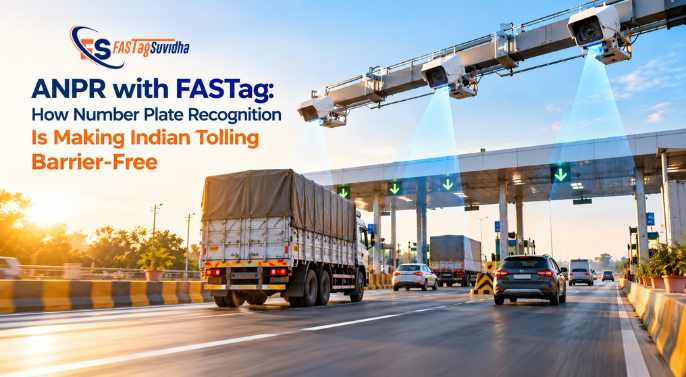
Not long ago, a highway trip meant slowing down, queuing behind trucks, and waiting for a barrier to lift. On several stretches of India’s national highways, that routine has already changed. Cameras read your number plate, your FASTag account is charged, and your vehicle keeps moving.
The technology behind this shift is Automatic Number Plate Recognition, or ANPR. This guide explains what it is, how it works with FASTag, where India stands with the rollout, and what drivers and fleet owners should do to avoid penalties.
Quick Answer
ANPR uses AI-powered cameras to read a vehicle’s number plate automatically. In India’s barrier-free tolling model, the camera identifies the vehicle, the system matches it to a FASTag account, and the toll is deducted without the vehicle stopping. If the balance is low or the tag is invalid, the owner receives an electronic notice (E-Notice) and must pay within a set window.
What Is Automatic Number Plate Recognition?
Automatic Number Plate Recognition is a system that captures a vehicle’s number plate using high-resolution cameras and converts the image into digital text using artificial intelligence. Once the plate is read, the system checks it against digital databases and triggers an action, such as opening a gate, charging a toll, or flagging a violation.
Because the process needs no human input, ANPR removes manual checks, which are slow and prone to error. That is why it is used well beyond highways:
- Toll plazas and expressways
- Parking facilities and residential societies
- Border check-posts and state entry points
- Fleet and logistics yards
- Industrial and corporate gates
- Traffic enforcement in smart cities
Whatever the setting, the goal is the same: identify the vehicle quickly, verify it digitally, and act on the result.
How ANPR Technology Works, Step by Step
An ANPR system looks simple from the road, but several stages run within a fraction of a second.
1. Image capture. Cameras positioned over or beside the lane photograph each vehicle. Modern units use infrared illumination and fast shutters, so they can capture plates in low light, at highway speed, and in rain or fog.
2. Vehicle and plate detection. Deep learning models find the vehicle in the frame and then locate the number plate on it. Good models handle tilted angles, motion blur, and plates of different sizes.
3. Character recognition. Optical character recognition (OCR), strengthened by machine learning, reads the letters and digits. Because the models learn from large datasets of plates, accuracy improves over time, particularly with the mix of fonts and formats seen on Indian roads.
4. Database verification. The extracted number is matched against registration records, tolling systems, and security or enforcement databases in real time.
5. Automated action. Based on the result, the system can approve entry or exit, deduct a FASTag toll, generate an alert, or issue an e-challan.
The entire chain is designed to run without a person stepping in, which is what makes high-speed, contactless operation possible.
How ANPR and FASTag Work Together
FASTag has long been the backbone of electronic toll payment in India. It uses a radio-frequency identification (RFID) sticker on the windscreen that is read at the toll lane, and the fee is debited from a linked prepaid account.
ANPR adds a second layer of identification. Instead of depending only on a tag being read by a lane reader, cameras confirm the vehicle by its plate. The two systems then cross-check each other:
- The camera reads the number plate.
- The system finds the FASTag account linked to that vehicle.
- The toll is calculated for the vehicle category and deducted automatically.
- The vehicle continues without stopping.
This pairing matters for two reasons. First, it makes free-flow tolling workable, because the system does not need the vehicle to slow down for a reader. Second, it creates a fallback. If a tag is missing, damaged, or not working, the plate still identifies the vehicle, so the toll can be pursued through a notice rather than being lost.
ANPR vs MLFF: What Is the Difference?
These two terms often appear together, so it helps to separate them.
ANPR is the camera-based identification technology. It is a component.
Multi-Lane Free Flow (MLFF) is the complete tolling model. It removes physical barriers and booths so that vehicles in any lane pass at normal speed, with tolls charged electronically using ANPR plus FASTag.
In short, ANPR is the eyes, FASTag is the payment channel, and MLFF is the system built from both. If you want a deeper look at the model itself, see our guide to MLFF tolling.
Where India Stands: Barrier-Free Tolling in 2026
Barrier-free tolling has moved from plan to practice during 2026.
NHAI launched India’s first MLFF system at the Chorayasi Toll Plaza on the Surat–Bharuch stretch of NH-48 in Gujarat in early May 2026. Around 41,500 vehicles used the corridor on its first day. Rajasthan followed on the Delhi–Jaipur section of NH-48, beginning with Daulatpura in June, then Manoharpura, and finally Shahjahanpur in August. NHAI says this made the Manesar-to-Jaipur journey barrier-free.
At the policy level, the government has chosen to build MLFF on ANPR, AI, and FASTag-based RFID rather than introducing GPS-based tolling at this stage. According to the ministry’s statement in Parliament, the barrier-free system has been awarded for 17 toll plazas, five of which were operational at that time, with bids invited for another 104 plazas. The same statement noted that FASTag accounts for over 98% of toll collections on national highways.
Enforcement is moving the same way. Uttarakhand deployed an AI-based ANPR e-detection system at major toll plazas and state entry points, linked with FASTag and the VAHAN vehicle database. During the initial rollout, it scanned over 49,000 vehicles in a single day and flagged more than 1,500 for invalid documents. The system cross-checks records such as registration, insurance, pollution certificate, fitness, permits, and road tax, then sends e-challans and SMS alerts to owners without manual intervention.
Rollout details change quickly, so check NHAI announcements for the latest list of MLFF plazas on your route.
What Drivers Need to Know: The E-Notice Rule
Barrier-free tolling has no booth where you can sort out a problem on the spot. That makes the E-Notice system the most important thing for drivers to understand.
Under the MLFF framework, if your FASTag balance is insufficient, or your tag is invalid or non-functional, the system issues an E-Notice linked to your vehicle. You then have 72 hours to pay the normal toll fee. If you miss that window, the fee is charged at twice the normal rate for your vehicle category. NHAI has also indicated that continued non-payment can lead to FASTag blacklisting and restrictions on vehicle-related services through the VAHAN platform.
Notices can be paid through the official parivahan fee-notice portal and the RajmargYatra app. Always use official channels, and be cautious of messages that ask for payment through unfamiliar links.
A Simple Checklist to Avoid Penalties
Most notices are avoidable. These habits keep you clear of trouble:
- Keep a healthy balance. Maintain more than the expected toll for your route, especially on long trips with several plazas.
- Check balance before you travel. A quick look takes seconds. You can do it with our FASTag balance check page.
- Recharge in advance. Top up through the FASTag recharge service rather than waiting until a low-balance alert.
- Keep the tag in good condition. It should be fixed properly on the inside of the windscreen and not damaged or covered.
- Match your tag to your vehicle. Make sure the tag is linked to the correct registration number and vehicle class.
- Keep your plate readable. Clean, standard, undamaged number plates are read more accurately by cameras.
- Update contact details. Notices and alerts reach you through your registered mobile number, so make sure it is current.
- Keep documents valid. Where ANPR enforcement is linked to registration, insurance, and pollution records, expired papers can trigger challans.
Beyond Tolling: Other Uses of ANPR
While tolling gets the headlines, ANPR is useful across the transport ecosystem.
Logistics and fleet management. Operators can verify vehicles at depots, track dispatch and arrival times, and reduce idle time at gates.
Parking management. Vehicles enter and leave without paper tickets or manual cash handling, and billing is based on automatic entry and exit records.
Smart cities. Cities use ANPR for traffic monitoring and detecting violations such as red-light jumping and stop-line crossing.
Border and security checkpoints. Authorities can verify vehicles quickly and flag those with compliance issues or alerts.
Corporate and industrial campuses. Only authorised vehicles are admitted automatically, and every movement is recorded.
Each of these shares the same advantage: faster processing with a digital record at every step.
Key Benefits of ANPR Technology
Speed. Vehicles are identified in a moment, so queues shrink and traffic keeps flowing.
Contactless operation. Drivers do not need to stop, roll down windows, or handle payments at the lane.
Accuracy. Automated reading reduces the human errors common in manual entry and inspection.
Fuel and emissions savings. Less stopping and idling means lower fuel use and fewer emissions.
Transparency. Every transaction creates a digital record, which makes toll and notice histories easier to review.
Lower operating cost. Barrier-free plazas need less physical infrastructure and fewer staff on the ground.
Challenges and Responsible Use
A fair view of ANPR includes its limits.
Read accuracy. Damaged, dirty, or non-standard number plates can be misread. Strong systems include review steps for doubtful reads.
Data privacy. Plate data links a vehicle to places and times. Operators should follow clear rules on how long data is kept, who can see it, and what it is used for.
Awareness gaps. Many drivers are still unfamiliar with E-Notices and the 72-hour window. Public education is as important as the cameras.
Dependence on clean records. The system works best when vehicle and FASTag data are accurate. Wrong linking or outdated records lead to wrong charges.
Addressing these points is part of making barrier-free tolling trusted as well as efficient.
Frequently Asked Questions
ANPR stands for Automatic Number Plate Recognition. It is a camera-and-AI system that reads vehicle number plates automatically and verifies them against digital records.
No. ANPR works with FASTag. The camera identifies the vehicle, while FASTag remains the payment account from which the toll is deducted.
Yes. A valid, working FASTag with enough balance is how your toll is paid automatically. Without it, you are likely to receive an E-Notice.
You receive an E-Notice and must pay the normal fee within 72 hours. After that, the fee is charged at twice the normal rate.
Systems use infrared lighting and fast shutters to handle low light, speed, and poor weather. Accuracy still depends on plate condition and camera quality.
It is used in parking systems, fleet yards, border check-posts, industrial gates, and traffic enforcement across smart cities.
Follow NHAI announcements and official highway advisories, as the list of MLFF plazas is expanding. Plan your balance for the full journey either way.
Final Thoughts
ANPR is turning highway tolling from a stop-and-pay routine into a seamless, automated process. Paired with FASTag, it supports faster travel, lower emissions, and more transparent toll records. For drivers and fleet owners, the practical takeaway is simple: keep your FASTag active, funded, and correctly linked to your vehicle, and barrier-free travel works in your favour.
Looking for ANPR solutions or FASTag services for your business? Explore our ANPR service page, or download the Fastag Suvidha app to recharge, check balances, and manage your tags in one place.