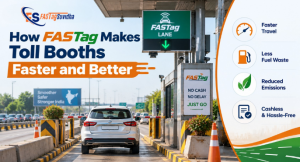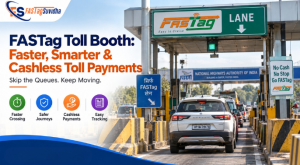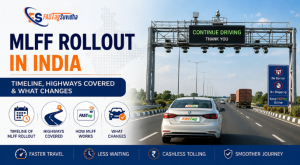
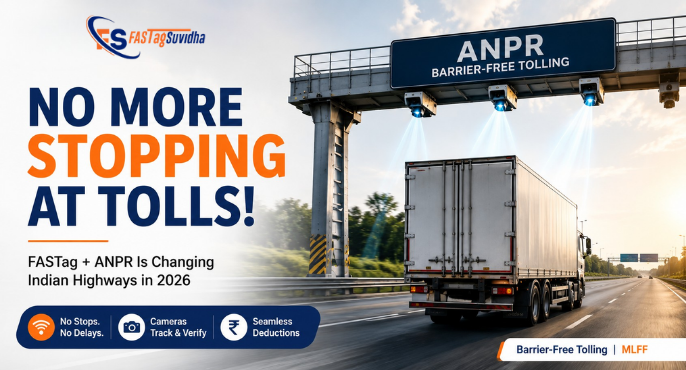
FASTag ANPR barrier-free tolling combines your existing FASTag’s RFID chip with number-plate-reading cameras so vehicles can cross a toll plaza without stopping at a boom barrier. It is already live on stretches like Delhi-Jaipur (NH-48) and Choryasi in Gujarat, with more plazas in procurement. It is not a replacement for FASTag (you still need an active, funded FASTag), and it is separate from the GPS/satellite tolling pilot, which the government has confirmed is not going nationwide yet.
What Is FASTag ANPR Barrier-Free Tolling?
FASTag ANPR barrier-free tolling, officially called Multi-Lane Free Flow (MLFF) tolling, is a toll collection method that pairs your vehicle’s FASTag RFID tag with overhead Automatic Number Plate Recognition cameras, removing the physical boom barrier so vehicles pass through without stopping. The RFID reader identifies the account and deducts the fare, while the ANPR camera cross-checks the vehicle’s number plate as a second verification layer, so the system can still bill a vehicle correctly even if the RFID read is weak or the tag is damaged.
This is the model the government confirmed after media reports claimed a nationwide satellite-based toll system was launching. The Ministry of Road Transport and Highways stated clearly that no such nationwide switch had been approved, and that the ANPR-FASTag barrier-less approach would instead be rolled out at selected plazas. Fastag Suvidha’s ANPR and MLFF service pages cover the underlying technology in more depth if you want to go deeper on either component.
For most of the last decade, FASTag’s biggest contribution was replacing cash at the toll booth. It cut transaction time from roughly 30-60 seconds to just a few seconds, but the boom barrier itself was still the bottleneck: every vehicle still had to slow down, wait for the RFID scan to clear, and wait again for the barrier arm to lift. On a busy interstate corridor during a festival weekend or a Monday morning office rush, that few-second pause per vehicle adds up into exactly the kind of queue FASTag was supposed to eliminate. Barrier-free tolling is the next logical step in that same journey: it doesn’t just speed up payment, it removes the physical obstacle that was forcing vehicles to slow down in the first place. In practical terms, the toll plaza starts to disappear as a distinct “stop” on your journey and becomes closer to an overhead sensor gantry, similar to what you’d see on a fully electronic urban expressway abroad.
It’s also worth being precise about ownership and terminology here, since a lot of casual coverage blurs the lines. The National Highways Authority of India (NHAI) is the implementing body on the ground, while the Indian Highways Management Company Limited (IHMCL), an NHAI-promoted entity, handles the electronic tolling architecture, including the FASTag ecosystem and the technology tenders for MLFF systems. When you see terms like “MLFF,” “ANPR-FASTag barrier-less tolling,” and “barrier-free tolling” used interchangeably in the news, they’re all describing the same underlying system described above.
How the System Actually Works at the Toll Plaza
RFID reading vs. camera-based ANPR verification
At a conventional FASTag lane, a boom barrier stays down until the RFID reader confirms payment, and that pause is exactly what still causes queues during peak hours. At a barrier-free MLFF plaza, there is no barrier at all. The RFID reader and ANPR cameras work together in real time as the vehicle drives through at normal speed, and the fare is deducted from the linked FASTag account within seconds.
What happens when your FASTag balance is low
This is the part most drivers get wrong. Barrier-free doesn’t mean fare-free. If a vehicle passes through with an inactive, blacklisted, or insufficiently funded FASTag, the system automatically generates an Electronic Notice (E-Notice). The driver then gets a 72-hour window to pay the standard toll amount. Miss that window, and the charge doubles to twice the standard vehicle-category rate. In effect, barrier-free tolling shifts the penalty from “wait at the barrier” to “pay a fine later,” which is exactly why keeping your FASTag topped up matters more, not less, under this system.
The E-Notice itself is generated automatically once the ANPR camera and RFID reader together flag a failed or incomplete transaction, and it’s tied back to the vehicle through VAHAN database integration, the same national vehicle registration database used for RC verification and other compliance checks. That’s an important detail: because the notice is linked to your registration number rather than just your FASTag account, ignoring it doesn’t make it disappear. Repeated unpaid notices can also affect your FASTag’s status the next time you try to recharge or link it to a new bank account. For drivers who use highways occasionally, this is a fairly minor administrative step: pay within 72 hours and it’s a non-issue. For daily commuters or fleet operators running dozens of vehicles across barrier-free stretches, though, it changes the operational discipline needed: balance monitoring, KYC renewal, and tag replacement need to happen proactively rather than reactively, since there’s no longer a barrier physically stopping a problem vehicle from entering the highway in the first place.
Which Highways and Plazas Are Already Barrier-Free (2026)
As of mid-2026, barrier-free tolling has moved from pilot to commercial operation on several corridors:
- Choryasi, Gujarat: India’s first commercial MLFF operation, live since May 2026
- Manoharpura and Daulatpura, Rajasthan: among the earliest free-flow conversions
- Shahjahanpur, Rajasthan: its conversion made the entire Delhi-Jaipur stretch of NH-48 fully barrier-free
- Mundka, Delhi and Gharaunda, Haryana: additional early-adopter plazas
- Chennai Bypass (Thiruneermalai and Athipattu-Menambedu): currently in the procurement/tendering stage, not yet operational
Beyond these, the Ministry has invited bids for the technology at roughly 104 additional toll plazas, signalling this is heading toward a broader national rollout rather than a one-off trial.
It’s worth noting how quickly this list has grown. India’s first genuinely barrier-free stretch, the Delhi-Meerut Expressway, was originally conceived as a pilot for exactly this ANPR-cum-FASTag multi-lane free-flow model, with the plan to expand it to other highways only once the pilot proved reliable. What started as a single testbed corridor a few years ago has, by 2026, turned into commercial operation across multiple states (Gujarat, Rajasthan, Delhi, and Haryana), with Tamil Nadu’s Chennai Bypass now moving through procurement. That pace matters for two reasons. First, if you regularly drive one of the corridors not yet listed here, it’s realistic to expect a transition within the next year or two, not the next decade. Second, for businesses and agents operating in the FASTag ecosystem, this isn’t a distant future scenario to plan for casually. It’s an active rollout that’s already reshaping how tolling works on some of the country’s busiest routes, including the Delhi-NCR to Jaipur corridor used heavily by both private and commercial traffic.
Is This the Same as GPS/Satellite Tolling?
No, and this is worth clarifying because the two get confused constantly. GNSS/satellite-based tolling, which would charge vehicles based on actual distance travelled via an on-board GPS unit, is still in a separate policy-development and pilot phase, currently focused on commercial vehicles fitted with Vehicle Location Tracking (VLT/AIS-140) devices. FASTag ANPR barrier-free tolling is a nearer-term, already-commercial system that keeps FASTag as the payment mechanism and simply removes the barrier. If you drive a private car in 2026, the system you’re actually going to encounter on the highway is FASTag + ANPR, not GPS tolling.
The confusion is understandable, because both systems share the same end goal (letting vehicles travel without stopping at a toll booth), and both have been discussed in the same news cycles. But the mechanics are fundamentally different. GNSS tolling would eventually charge based on exact distance travelled, tracked via satellite positioning, and doesn’t require any physical toll infrastructure on the road at all; it’s the model some European toll systems use for heavy trucks. FASTag ANPR tolling, by contrast, still relies on physical plaza infrastructure, cameras and RFID readers mounted on gantries at fixed points, and it just removes the barrier arm that used to force a stop. That distinction is exactly why the government pushed back so firmly on reports of an imminent satellite-based switch: the two systems are on completely different timelines, and conflating them created the impression that FASTag itself was being phased out, which it isn’t. For the foreseeable future, FASTag remains the backbone of Indian toll collection, whether the plaza you’re driving through has a barrier or not.
What Changes for Drivers
| Old FASTag lane (with barrier) | New barrier-free (ANPR + FASTag) lane |
| Vehicle stops briefly for barrier to lift | Vehicle passes at normal speed, no stop |
| Payment failure = blocked at barrier | Payment failure = E-Notice, 72-hr grace period |
| Single verification (RFID only) | Dual verification (RFID + number plate) |
| Toll penalty for no FASTag: 2x rate immediately | Same 2x rate applies if E-Notice unpaid after 72 hours |
The core driver takeaway: keep your FASTag recharged and your KYC updated, because the “penalty moment” now happens after the fact via SMS/E-Notice rather than in front of you at the barrier. You can also check your FASTag balance before a long highway trip to avoid an E-Notice altogether.
What Changes for Toll Operators and FASTag Agents
For operators, MLFF reduces staffing needs at the barrier itself but increases dependency on backend systems, namely ANPR camera uptime, VAHAN database integration for E-Notice generation, and customer support to resolve disputed notices. Toll concessionaires also take on new operational risk: a camera outage or a misread number plate under a barrier-free model doesn’t just delay one vehicle at a barrier, it can generate an incorrect E-Notice that a driver then has to dispute after the fact, which is a very different customer-service problem than the one toll operators managed under the old barrier system.
For FASTag agents and channel partners, this shift actually increases the importance of the agent network rather than reducing it. As more plazas go barrier-free, drivers with expired KYC, damaged tags, or low balances won’t be stopped and warned at the barrier the way they used to be. Instead, they’ll find out days later via an SMS notice, often after they’ve already been charged a penalty rate. That creates a new category of frustrated customer who needs help fast: someone who wants to know why they got an E-Notice, how to dispute it if it was a system error, and how to make sure it doesn’t happen again. Agent-assisted recharge, tag replacement, and KYC correction become more valuable services under this model, not less, because the margin for error at the point of travel has effectively disappeared. It’s also a good reminder that a barrier-free highway is not a FASTag-free highway: recharge and account health still route through agents and partner networks like FASTag Suvidha’s, and if anything, the stakes of staying on top of that account health just went up. If you’re exploring the business side of this shift, our FASTag agent and channel partner program is built around exactly this growing demand for on-ground support.
What’s Coming Next
- Wider rollout: bids are already out for around 104 more plazas beyond the initial pilots.
- Chennai Bypass and other metro bypass corridors moving from pilot to procurement.
- FASTag Annual Pass: revised to ₹3,075 (from ₹3,000) effective April 1, 2026, covering 200 crossings or 12 months at eligible NHAI plazas, a detail that matters more as barrier-free plazas make frequent, fast crossings more common.
- GNSS/satellite tolling remains a slower-moving, separate track focused on commercial vehicles for now.
FAQ
It’s a toll system that combines your FASTag’s RFID chip with number-plate-reading cameras so vehicles can cross a toll plaza without stopping at a barrier. It’s also called Multi-Lane Free Flow (MLFF) tolling.
Yes. Barrier-free tolling still charges through your FASTag account. Removing the barrier doesn’t remove the toll; it just removes the physical stop.
The system issues an Electronic Notice (E-Notice) and gives you 72 hours to pay the standard fare. If unpaid after that window, the charge doubles.
No. The government has publicly clarified there is no nationwide satellite-based tolling launch. GNSS tolling remains a separate, slower pilot currently focused on commercial vehicles.
Confirmed operational stretches include Choryasi (Gujarat), the Delhi-Jaipur section of NH-48 (via Manoharpura, Daulatpura, and Shahjahanpur plazas), Mundka (Delhi), and Gharaunda (Haryana), with roughly 104 more plazas in the bidding pipeline.
₹3,075 for eligible private non-commercial vehicles, covering 200 toll crossings or 12 months, whichever comes first.
The Toll Booth Is Disappearing, But FASTag Isn’t
FASTag ANPR barrier-free tolling marks the biggest shift in Indian highway tolling since FASTag became mandatory in 2021. Boom barriers are quietly disappearing on corridor after corridor, from Choryasi in Gujarat to the entire Delhi-Jaipur stretch of NH-48, with roughly 104 more plazas already in the bidding pipeline. What hasn’t changed is that FASTag still powers every one of these transactions. Removing the barrier doesn’t remove the toll; it just moves the moment of truth from the plaza itself to an SMS notice sent later.
That means drivers now need to stay ahead of their FASTag account, keeping KYC current and balance funded, rather than relying on a barrier to catch a problem in real time. Whether you’re a daily commuter, a fleet operator, or exploring the business opportunity behind India’s toll ecosystem, one thing is clear: barrier-free is coming to a highway near you. FASTag Suvidha can help you stay ready for it.