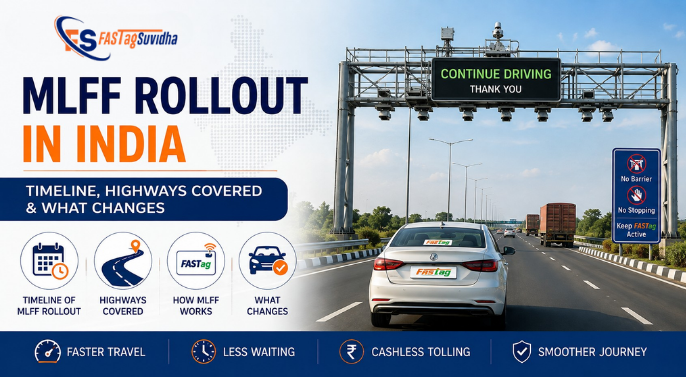
India is moving toward a new era of barrierless toll collection with the rollout of Multi-Lane Free Flow (MLFF) technology.
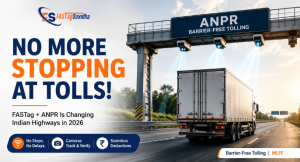
Instead of making vehicles stop at traditional toll booths, MLFF is designed to identify vehicles while they are moving and process toll payments electronically using technologies such as FASTag, RFID and Automatic Number Plate Recognition (ANPR).
For car owners, truck drivers and fleet operators, this can mean fewer stops and smoother highway journeys.
But the transition is happening in phases.
What Is MLFF?
MLFF stands for Multi-Lane Free Flow.
It is a barrierless tolling system that allows vehicles to pass through a designated tolling area without stopping at a conventional toll booth.
In a traditional toll plaza, a vehicle typically slows down, enters a toll lane, completes the transaction, and continues after the barrier opens.
With MLFF, cameras, sensors and electronic identification technologies detect the vehicle as it passes through the tolling zone.
The system can use:
- FASTag and RFID
- Automatic Number Plate Recognition (ANPR)
- Cameras and vehicle detection technology
- Electronic toll collection systems
- Digital transaction and enforcement mechanisms
Traditional Tolling vs MLFF
Traditional tolling:
Vehicle → Queue → Toll Lane → Stop → Payment → Barrier Opens → Continue
MLFF:
Vehicle → Detection → Identification → Electronic Toll Processing → Continue
The core idea is simple:
Instead of bringing the vehicle to the toll booth, the tolling system works around the moving vehicle.
MLFF Rollout in India: Timeline
The adoption of MLFF is taking place in phases across selected National Highway fee plazas.
Here are the major milestones in the rollout.
August 2025: Implementation Plans Begin
In August 2025, Indian Highways Management Company Limited (IHMCL), promoted by NHAI, signed an agreement with ICICI Bank to implement an MLFF system at Choryasi Fee Plaza on NH-48 in Gujarat.
NHAI also announced plans to introduce MLFF at around 25 National Highway fee plazas during FY 2025–26.
This created the foundation for India’s move toward large-scale barrierless tolling.
1 May 2026: First MLFF System Goes Live
India’s first operational MLFF barrierless tolling system was launched at Choryasi Toll Plaza on the Surat–Bharuch section of NH-48 in Gujarat.
The system was designed to allow vehicles to pass through the tolling zone without stopping at a conventional barrier.
This marked a major milestone in India’s electronic toll collection journey.
May 2026: MLFF Reaches Delhi
The rollout expanded to the National Capital Region with barrierless tolling at Mundka–Bakkarwala on UER-II in Delhi.
The deployment brought the concept of free-flow tolling closer to a major urban and logistics market.
June 2026: Daulatpura, Rajasthan
On 19 June 2026, NHAI launched MLFF at Daulatpura Toll Plaza on the Delhi–Jaipur section of NH-48.
The Delhi–Jaipur corridor is an important route for both passenger and commercial traffic.
June 2026: Gharaunda, Haryana
On 25 June 2026, MLFF was introduced at Gharaunda Toll Plaza on the Panipat–Jalandhar section of NH-44.
This expanded barrierless tolling to another important north Indian highway corridor.
July 2026: Manoharpura, Rajasthan
On 1 July 2026, MLFF was launched at Manoharpura Toll Plaza, also on the Delhi–Jaipur section of NH-48.
The deployment added another barrierless tolling point to the corridor.
August 2026: Shahjahanpur, Rajasthan
On 1 August 2026, NHAI launched MLFF at Shahjahanpur Toll Plaza on NH-48.
This became another important milestone in the expansion of MLFF on the Delhi–Jaipur route.
Which Highways Have MLFF in India?
The network is expanding gradually rather than switching every toll plaza to MLFF at the same time.
Several fee plazas have been selected or awarded for implementation, while some are already operational.
Key locations associated with the rollout include:
| Highway | MLFF Location | State/Region |
| NH-48 | Choryasi | Gujarat |
| NH-48 | Daulatpura | Rajasthan |
| NH-48 | Manoharpura | Rajasthan |
| NH-48 | Shahjahanpur | Rajasthan |
| NH-44 | Gharaunda | Haryana |
| UER-II | Mundka–Bakkarwala | Delhi |
| NH-48 | Nemili / Sriperumbudur | Tamil Nadu |
| NH-48 | Chennasamaduram | Tamil Nadu |
| NH-45 | Paranur | Tamil Nadu |
| NH-44 | Kasepalli | Andhra Pradesh |
| NH-44 | Amakthadu | Andhra Pradesh |
| NH-44 | Marur | Andhra Pradesh |
| NH-50 | Chalakwadi | Maharashtra |
| NH-50 | Hiwargaon Pavasa | Maharashtra |
| NH-19 | Badarpur–Faridabad | Haryana |
| NH-48 | Boraich | Gujarat |
| NH-31 | Madanpur | Assam |
Important to Know
A toll plaza being selected or awarded for MLFF implementation does not necessarily mean that MLFF is already operational there.
The rollout is phased, so travellers should verify the latest status of a particular toll plaza before relying on free-flow tolling.
How Does MLFF Work With FASTag?
A common question is:
If there is no toll booth, how will the toll be deducted?
MLFF combines multiple technologies to identify and process a vehicle.
1. Vehicle Enters the MLFF Zone
The vehicle moves through the designated tolling area without stopping at a physical toll barrier.
2. FASTag Is Identified
RFID technology associated with the FASTag can identify the vehicle’s electronic toll tag.
3. ANPR Captures the Number Plate
Cameras use Automatic Number Plate Recognition technology to identify the vehicle registration number.
4. Vehicle Data Is Verified
The system can use available information to validate the tolling event.
5. Toll Is Processed Electronically
The applicable toll transaction is processed through the electronic toll collection ecosystem.
6. The Vehicle Continues
There is no conventional barrier requiring the driver to stop and wait.
This makes FASTag + ANPR + automated tolling an important combination in India’s transition toward barrierless highways.
MLFF vs Traditional Toll Plaza
| Feature | Traditional Toll Plaza | MLFF |
| Physical barrier | Generally used | Barrierless |
| Vehicle stopping | May be required | Designed to avoid stopping |
| Toll collection | Electronic/manual depending on lane | Electronic |
| FASTag | Widely used | Key component |
| ANPR | May be used | Important identification technology |
| Human intervention | Comparatively higher | Lower |
| Traffic flow | Lane-based | Multi-lane/free-flow |
| Queue formation | Possible | Designed to reduce queues |
The biggest change is not simply the removal of a toll barrier.
MLFF changes the tolling experience from stop-and-pay to detect-and-process
What Will Change for Drivers?
The practical impact of MLFF will be most noticeable at tolling points.
Less Stopping
Vehicles using an MLFF-enabled tolling zone are designed to pass through without stopping at a physical toll barrier.
Smoother Traffic Flow
Removing the need for conventional toll-barrier processing can help vehicles maintain a more continuous flow.
Less Waiting at Toll Points
During busy periods, traditional toll plazas can develop queues. MLFF is intended to reduce this stop-and-go movement.
More Dependence on Digital Systems
As tolling becomes increasingly automated, FASTag status, vehicle information and electronic transactions become more important.
What Does MLFF Mean for Truckers and Fleet Operators?
For commercial vehicles, small delays can become significant when repeated across multiple trips.
A truck travelling between major logistics hubs may cross several tolling points during a journey.
If every stop takes additional time, the cumulative impact can affect:
- Delivery schedules
- Driver utilisation
- Vehicle utilisation
- Route efficiency
- Fuel consumption
- Fleet planning
MLFF is designed to reduce unnecessary stopping at covered tolling locations.
For fleet operators, this can support a more efficient highway journey.
But There Is Another Important Change
As toll collection becomes more automated, digital transaction management becomes more important.
Fleet managers may need to pay closer attention to:
- FASTag status
- FASTag balance
- Toll deductions
- Vehicle-tag mapping
- Transaction history
- Payment exceptions
This is where digital FASTag and vehicle-management tools can become useful.
What Should You Check Before Travelling on an MLFF Highway?
MLFF removes the need for a conventional toll stop, but drivers still need a working electronic toll setup.
Before a long highway journey, check the following.
1. Check Your FASTag Status
Make sure the FASTag is active and properly associated with your vehicle.
Internal link opportunity: Link FASTag status check to the relevant FastagSuvidha page.
2. Maintain Sufficient FASTag Balance
A sufficient balance can help avoid unnecessary transaction issues during your journey.
3. Verify Vehicle Details
Make sure the vehicle information associated with the FASTag is accurate.
4. Keep Vehicle Documents Updated
Maintain valid vehicle documentation such as registration, insurance and other applicable documents.
5. Review Toll Transactions
After travelling, check your transaction history and confirm that deductions match your journey.
What Happens If an MLFF Toll Payment Fails?
This is an important difference between conventional toll plazas and barrierless tolling.
At a traditional toll plaza, a driver may be able to interact directly with toll personnel when a transaction fails.
With MLFF, the process is more dependent on digital identification and transaction systems.
That means drivers and fleet operators should maintain accurate FASTag and vehicle information.
For businesses operating multiple trucks, regular transaction monitoring can help identify issues such as:
- Failed transactions
- Unexpected deductions
- Vehicle-tag mismatches
- Payment exceptions
- Toll reconciliation issues
As India’s tolling infrastructure becomes more automated, digital toll management will become increasingly important for fleet operations.
Why Is India Moving Towards Barrierless Tolling?
The move toward MLFF is part of a wider effort to make highway travel more efficient and technology-driven.
India has a large and growing National Highway network. With increasing passenger and freight movement, toll plazas need to handle high traffic volumes without becoming bottlenecks.
MLFF can help address this challenge by moving toll collection away from a physical stopping point.
The potential benefits include:
- Better traffic flow
- Reduced waiting at toll locations
- Lower vehicle idling
- Greater automation
- Reduced manual intervention
- Digital toll transactions
- More efficient highway movement
For India’s logistics sector, even small improvements in journey efficiency can matter because commercial vehicles operate across thousands of kilometers and multiple trips.
MLFF and ANPR: What Is the Role of Number Plate Recognition?
ANPR stands for Automatic Number Plate Recognition.
It uses cameras and image-processing technology to capture and recognize vehicle registration numbers.
In an MLFF environment, ANPR can complement FASTag-based vehicle identification.
This provides an additional way to identify the vehicle moving through the tolling zone.
The combination is important because barrierless tolling needs reliable vehicle identification without requiring the driver to stop.
FASTag identifies the electronic tag.
ANPR identifies the vehicle registration number.
Together, these technologies can support a more automated tolling environment.
Is MLFF the Future of FASTag?
FASTag has already transformed toll collection in India by enabling electronic toll payments.
MLFF takes the concept further.
The evolution can be viewed as:
Cash-based tolling → FASTag → Electronic Toll Collection → FASTag + ANPR → Multi-Lane Free Flow
FASTag primarily changed how tolls are paid.
MLFF changes how toll collection takes place on the road.
That distinction is important.
The future is not necessarily about faster toll booths.
It is about reducing the need for vehicles to stop at toll booths in the first place.
What Does MLFF Mean for the Future of Highway Travel?
The significance of MLFF goes beyond toll collection.
It represents a broader shift toward:
Automation + Digital Identification + Electronic Payments + Data + Free-Flow Traffic
For individual drivers, this can mean a smoother journey.
For truck operators, it can mean fewer unnecessary stops.
For fleet managers, it can create a greater need for accurate digital records and transaction monitoring.
And for India’s transport infrastructure, it represents another step toward technology-enabled highways.
Frequently Asked Questions
What is MLFF in India?
MLFF, or Multi-Lane Free Flow, is a barrierless tolling system designed to identify vehicles and process toll payments electronically while vehicles continue moving through the tolling zone.
What is the difference between MLFF and FASTag?
FASTag is an electronic toll identification and payment mechanism. MLFF is a broader tolling system that uses technologies such as FASTag, RFID and ANPR to support barrierless toll collection.
Where was India’s first MLFF toll plaza launched?
India’s first operational MLFF system was launched at Choryasi Toll Plaza on the Surat–Bharuch section of NH-48 in Gujarat on 1 May 2026.
Which highways have MLFF in India?
Selected locations on highways including NH-48, NH-44, NH-45, NH-50, NH-19 and NH-31, along with UER-II in Delhi, have been included in the MLFF implementation pipeline.
Do vehicles have to stop at MLFF toll plazas?
MLFF is designed to allow vehicles to pass through the tolling zone without stopping at a physical toll barrier.
Is FASTag required for MLFF?
FASTag is an important part of the electronic toll collection ecosystem used in India’s MLFF implementation. Vehicle owners should therefore ensure their FASTag is active and correctly associated with their vehicle.
Is MLFF already available everywhere in India?
No. The implementation is being carried out in phases. Some locations are operational, while others are at different stages of implementation.
When will MLFF be implemented across India?
The transition is being carried out progressively. A projection associated with the Economic Survey 2025–26 indicated a target of implementing MLFF across four-lane-and-above National Highways and expressways by March 2029.
Conclusion
The MLFF rollout in India is changing the way highway tolling is being designed.
With FASTag, RFID, ANPR and automated tolling infrastructure, vehicles can pass through covered tolling zones without relying on traditional physical barriers.
The rollout has already moved beyond its first deployment, with MLFF now associated with selected toll plazas across important corridors such as NH-48 and NH-44.
For drivers, the biggest expected benefit is simple:
Less stopping. Less waiting. Smoother travel.
For truckers and fleet operators, the impact could extend to better journey efficiency and more streamlined toll transaction management.
However, MLFF does not eliminate the importance of FASTag. Instead, it makes having an active FASTag, correct vehicle information and reliable digital toll records even more important.
As India continues its transition toward barrierless highways, understanding MLFF today can help drivers, transporters and fleet operators prepare for the next generation of electronic toll collection.
The future of tolling is moving from stopping at the toll booth to driving through it.