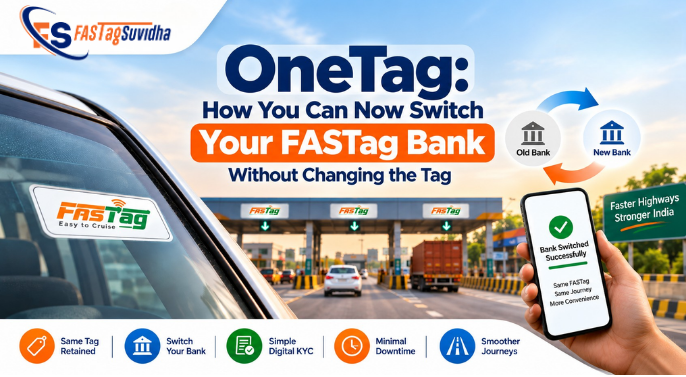
For years, changing your FASTag issuing bank meant one thing: buying a brand-new tag, going through fresh KYC, and waiting for it to get activated -all while your old tag sat blacklisted on your windscreen. That friction is now gone. In September 2026, Union Minister for Road Transport and Highways Nitin Gadkari launched OneTag, a new National Highways Authority of India (NHAI) facility that allows FASTag users to switch their issuing bank without replacing the physical tag itself.
For millions of vehicle owners -and especially for commercial fleet operators who rely on FASTag every single day – this is one of the most practical upgrades to India’s electronic toll collection ecosystem since the Annual Pass was introduced in August 2025. In this article, we break down what OneTag is, why it matters, how it works, and what it means for both private vehicle owners and the trucking community.
What Is OneTag?
OneTag is an NHAI-backed initiative that decouples your FASTag’s physical RFID sticker from its issuing bank. Traditionally, every FASTag is tied to a specific bank account – SBI, ICICI, Paytm Payments Bank, Axis, or any of the other empanelled issuers. If you wanted to move to a different bank for better service, lower recharge charges, or a better app experience, you had no choice but to deactivate your existing tag and install a completely new one.
With OneTag, that requirement disappears. The tag stuck on your windshield stays exactly where it is. What changes is the backend -the bank or payment service provider linked to that tag ID. In effect, OneTag turns your FASTag from a bank-specific product into a portable toll-payment identity, similar to how mobile number portability let you switch telecom operators without changing your phone number.
Why NHAI Introduced OneTag
FASTag has grown into one of India’s largest digital payment ecosystems for tolling, with transaction volumes now crossing 3.5 crore per day across the national highway network. But with scale came a recurring complaint: users felt locked into their issuing bank, even when service quality declined, recharge processes were clunky, or customer support was slow.
NHAI’s push toward a smoother, more user-centric tolling experience has been building for a while – the FASTag Annual Pass in August 2025 and the FASTag Local Pass expansion to 121 toll plazas earlier this year were both steps in that direction. OneTag continues that pattern: reduce friction, reduce paperwork, and let the existing tag infrastructure do more without physically reissuing anything. It’s a shift toward treating FASTag as a permanent vehicle credential rather than a bank product that needs periodic replacement.
How OneTag Works: A Step-by-Step Look
While the rollout details are still being operationalised across banks, the general process NHAI has outlined works like this:
- Check eligibility. Your existing FASTag must be active, properly linked to your vehicle registration number, and not currently blacklisted or under dispute.
- Initiate the switch request. This can be done through the RajmargYatra app or the NHAI/IHMCL portal, where you select your preferred new issuing bank from the list of empanelled partners.
- Complete KYC verification with the new bank. Since the account relationship is moving to a new issuer, a lightweight KYC check is still required – but this happens digitally, without needing a new physical tag.
- Backend linking. NHAI, through the Indian Highways Management Company Limited (IHMCL), updates the tag’s backend record so toll transactions now route to the new bank account.
- Confirmation and activation. Once the switch is confirmed, your FASTag continues functioning exactly as before at toll plazas -same tag, same windshield placement, new bank behind it.
The entire process is designed to avoid the two biggest pain points of the old system: physically replacing the tag and losing toll history continuity.
Who Benefits Most from OneTag?
Private vehicle owners get the freedom to choose banks based on service quality, recharge convenience, or better integration with their existing banking app -without the hassle of reinstallation.
Frequent highway travellers avoid the downtime between deactivating an old tag and activating a new one, which previously could mean a few days of unreliable toll payments.
Commercial and fleet operators stand to gain the most. This is where the connection to TruckSuvidha becomes especially relevant.
Why OneTag Matters for the Trucking and Fleet Industry
If you run a transport business or manage a fleet through , already know how much toll efficiency affects turnaround time. A truck stuck at a toll plaza because of a tag issue isn’t just an inconvenience -it’s lost hours, missed delivery windows, and in some cases, penalty charges from clients.
Fleet operators often manage FASTags across dozens or hundreds of vehicles, frequently through a single bank relationship for easier reconciliation. But banking relationships change -sometimes due to better commercial terms, sometimes due to service issues, sometimes because a fleet is consolidating its banking under one NBFC or financial partner. Before OneTag, switching meant re-tagging an entire fleet, coordinating with drivers across multiple routes, and risking toll delays during the transition window.
With OneTag, fleet managers using platforms like TruckSuvidha can now negotiate better banking terms or consolidate accounts without touching a single physical tag. This is a meaningful operational win: less downtime, simpler reconciliation, and one less administrative headache in an industry where margins are already tight. For businesses that coordinate loads, drivers, and route planning through TruckSuvidha, a smoother FASTag backend means fewer disruptions to the transport chain- which ultimately keeps deliveries on schedule and toll expenses predictable.
OneTag vs. the Old Tag-Replacement Process
| Aspect | Old Process | With OneTag |
| Physical tag | New tag required | Same tag retained |
| KYC | Full fresh KYC | Lightweight digital KYC |
| Downtime | Days of inactive tolling | Minimal to none |
| Fleet impact | Re-tagging every vehicle | Backend switch only |
| Toll history | Often reset or fragmented | Continuity preserved |
How to Prepare If You Want to Switch Banks Under OneTag
- Confirm your current FASTag is active and properly KYC-compliant.
- Check which banks are empanelled under the OneTag facility via the official NHAI or IHMCL channels.
- Keep your vehicle registration certificate and existing FASTag details handy for verification.
- For fleet owners, coordinate the switch during a low-traffic period to avoid any transaction mismatches during backend migration.
- Always initiate the process through official NHAI-recognised platforms -RajmargYatra app or IHMCL’s portal – rather than third-party links, to avoid fraud or misdirected KYC submissions.
Frequently Asked Questions
OneTag is an NHAI facility launched in September 2026 that lets FASTag users switch their issuing bank without replacing their existing physical tag.
No. OneTag is specifically designed so the same tag stays on your vehicle; only the backend bank linkage changes.
Yes, OneTag applies broadly across FASTag users, including commercial and fleet vehicles, making it especially useful for transport operators managing multiple tags.
OneTag was launched by Union Minister for Road Transport and Highways Nitin Gadkari, as part of NHAI’s ongoing FASTag digitalisation initiatives.
The intent of OneTag is to preserve tag continuity, meaning your toll transaction history remains tied to the same physical tag rather than resetting with a new one.
The FASTag Annual Pass is a toll-payment plan (₹3,000/year for up to 200 crossings), while OneTag is a bank-portability feature that lets you change your tag’s issuing bank without a new physical tag. The two serve different purposes and can be used independently.
The Bigger Picture: NHAI’s Push Toward a Frictionless FASTag Ecosystem
OneTag isn’t an isolated update – it’s part of a broader pattern of NHAI initiatives aimed at making electronic tolling simpler: the Annual Pass reduced recharge frequency, the Local Pass expansion brought digital exemptions to more communities near toll plazas, and now OneTag removes the last major barrier to switching banks. Together, these changes signal a tolling system that’s becoming more portable, more user-controlled, and less dependent on rigid, one-time setups.
For everyday drivers, this means more choice and less hassle. For the logistics and trucking sector – where every hour at a toll plaza has a cost – OneTag is a quiet but meaningful efficiency gain. As platforms like FastagSuvidha and TruckSuvidha continue to serve vehicle owners and fleet operators across India, updates like this reinforce a simple trend: digital toll infrastructure is finally starting to work the way users actually need it to.